


Summary: The Supreme Court’s use and of EU jurisprudence in Kapoor Glass—including the British Airways, TeliaSonera, Microsoft, and Intel cases—provides a rigorous framework to assess abuse of dominant position, emphasizing an effects-based analysis, objective justifications, and market evidence. These use of these cases reflect that India is with EU and US standards, prioritizing competitive harm over presumptive abuse, though diverging from China’s proactive stance. The Court’s approach ensures predictability for dominant firms but risks under-regulating in concentrated markets.
Introduction
The Supreme Court of India’s judgment in Kapoor Glass India Pvt. Ltd. v. Schott Glass India Pvt. Ltd. (2025 INSC 668), delivered May 13, 2025, is a landmark decision in Indian competition law, addressing allegations of abuse of dominant position under Section 4 of the Competition Act, 2002.
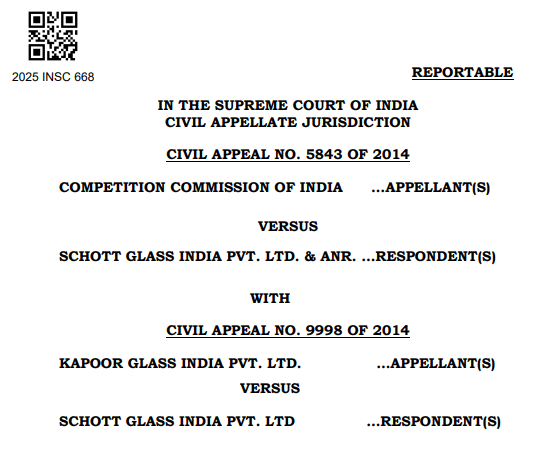
The case involved appeals by the Competition Commission of India (CCI) and Kapoor Glass India Pvt. Ltd. against a 2014 order of the Competition Appellate Tribunal (COMPAT), which overturned CCI’s findings that Schott Glass India Pvt. Ltd. abused its dominance in the market for neutral USP-I borosilicate glass tubing.
Factual Background
At the time of the complaint in 2010, Schott Glass India Pvt. Ltd. (Schott India), a subsidiary of Germany’s Schott AG, was (and still is) a leading manufacturer of neutral USP-I borosilicate glass tubing (clear and amber) used in pharmaceutical containers like ampoules and vials. In 2010, Kapoor Glass India Pvt. Ltd., a converter transforming tubing into containers, lodged a complaint with the CCI, alleging that Schott India abused its dominant position by:
- Offering exclusionary volume-based (target) discounts that coerced loyalty;
- Imposing discriminatory contractual terms, including functional rebates tied to a “no-Chinese tubing” clause;
- Refusing or rationing supply to independent converters while prioritizing its joint venture, Schott Kaisha Pvt. Ltd.; and
- Tying clear (NGC) and amber (NGA) tubing purchases to secure rebates.
Procedural History
The CCI, after a Director General (DG) investigation, found Schott India dominant with a 60-80% market share and concluded violations of Section 4(2)(a)-(e) (discriminatory pricing, output restriction, market access denial, tying, and leveraging dominance). It imposed a penalty of Rs. 5.66 crore (4% of three-year average turnover) and issued a cease-and-desist order.
Schott India appealed to COMPAT, which annulled the CCI’s order in 2014, finding insufficient evidence and procedural lapses (e.g., denial of cross-examination). Kapoor Glass also appealed, seeking broader relief.
The Supreme Court consolidated CCI’s appeal (Civil Appeal No. 5843 of 2014) and Kapoor Glass’s appeal (Civil Appeal No. 9998 of 2014) to resolve the dispute.
Key Legal Issues
The Supreme Court framed six issues for adjudication:
- Whether Schott India’s target-discount scheme constituted discriminatory or exclusionary pricing under Section 4(2)(a) and (b);
- Whether the functional-discount/“no-Chinese” scheme (and Trade-Mark Licence Agreement) imposed unfair or discriminatory conditions under Section 4(2)(a) and (b);
- Whether the Long-Term Tubing Supply Agreement (LTTSA) with Schott Kaisha caused a margin squeeze under Section 4(2)(e);
- Whether Schott India tied or bundled NGA and NGC tubes, breaching Section 4(2)(d);
- Whether an effects-based analysis is essential under Section 4, and if it was omitted by CCI; and
- Whether CCI’s investigation was vitiated by denial of cross-examination and breaches of natural justice.
Courts Reasoning and Findings
Market Definition and Dominance (Paragraphs 26-31)
Market Definition: The Court identified two distinct upstream product markets—Neutral Glass Clear (NGC) and Neutral Glass Amber (NGA)—due to their non-interchangeable physicochemical properties. The downstream market comprised pharmaceutical containers made from these tubes. India was treated as a single geographic market, given uniform transport costs and quality standards.
Dominance: Schott India held a 61-80% market share (2008-2010), reinforced by technological superiority, financial backing from Schott AG (€2.8 billion turnover), vertical integration via Schott Kaisha (30% offtake), and weak buyer power among fragmented converters. Under Section 19(4), these factors confirmed Schott India’s dominance in both NGC and NGA markets.
Issue 1 – Target-Discount Scheme (Paragraphs 32-39)
Allegation: CCI and Kapoor Glass argued that Schott India’s volume-based rebates (2%, 5%, 8%, 12% slabs) coerced converters to source exclusively from Schott, penalizing dual sourcing and violating Section 4(2)(a) (discriminatory pricing) and (b) (output restriction).
Findings: The Court held the scheme non-discriminatory, as rebates were based solely on purchase volume, uniformly applied to all converters. Differential outcomes (e.g., Schott Kaisha securing 12% rebates) reflected purchase quantities, not unequal treatment. The Court cited British Airways plc v. Commission (Case C-95/04 P, EUCJ, 2007), which requires discriminatory pricing to lack objective justification or treat equivalent customers differently. Schott’s rebates were justified by the need for stable furnace utilization at 1600°C, preventing refractory damage and securing economies of scale.
Evidence: Data showed increased converter purchases from Schott and rivals (Nipro-Triveni, imports) and stable container prices, negating foreclosure or output restriction claims. The Court dismissed CCI’s reliance on untested converter statements, finding no violation of Section 4(2)(a) or (b).
Issue 2 – Functional-Discount/“No-Chinese” Scheme (Paragraphs 40-45)
Allegation: The 8% functional rebate, tied to purchase plans, a “no-Chinese tubing” clause, and traceability obligations, was deemed exclusionary, favoring Schott Kaisha and restricting rival suppliers.
Findings: The Court found the rebate uniformly available to converters meeting quality and traceability conditions, with no differential pricing for equivalent transactions. The “no-Chinese” clause, withdrawn in 2010, was justified by evidence of substandard Chinese tubing (high alkali-release values), protecting patient safety and Schott’s reputation. The Court noted increased market shares for Nipro-Triveni (12% to 14%) and imports (620 to 1000 tonnes), alongside 38% downstream output growth and improved converter margins (11.4% to 13.7%), refuting market restriction claims under Section 4(2)(b)(i).
Rationale: Each condition (purchase plans, no-Chinese clause, inspections) was objectively tied to manufacturing efficiency and brand integrity, proportionate to legitimate aims. The Court rejected CCI’s findings, affirming no violation of Section 4(2)(a) or (b).
Issue 3 – LTTSA and Margin Squeeze (Paragraphs 46-53)
Allegation: The LTTSA, committing Schott Kaisha to source 80% of its tubing needs, offered exclusive rebates, price freezes, and priority dispatch, allegedly squeezing independent converters’ margins under Section 4(2)(e) (leveraging dominance across markets).
Findings: The Court dismissed the margin squeeze claim, applying TeliaSonera Sverige AB v. Konkurrensverket (Case C-52/09, EUCJ, 2011), which requires downstream participation, unsustainable margins for rivals, and competitive harm. Schott India operated only upstream, not downstream, and audited financials showed all converters maintained positive EBITDA, with seven improving margins. Schott Kaisha’s container prices matched or exceeded rivals’, negating foreclosure. The LTTSA was justified by a €25-million furnace rebuild, requiring assured offtake for optimal throughput.
Conclusion: The Court found no downstream participation, no margin compression, and no market foreclosure (imports rose 11% to 18%), ruling the LTTSA lawful under Section 4(2)(e).
Issue 4 – Tying of NGA and NGC Tubes (Paragraphs 54-58)
Allegation: Aggregating NGA and NGC purchases for rebates was alleged to tie the two products, breaching Section 4(2)(d) (supplementary obligations unrelated to the contract).
Findings: The Court, citing Microsoft Corp. v. Commission (Case T-201/04, EU General Court, 2007), held that tying requires distinct products, coercion, and foreclosure. NGA and NGC were not distinct, as both derived from the same furnace with minor compositional differences (iron oxide for NGA). No contract compelled dual purchases; converters could buy single grades at list prices. Rebate aggregation was a multi-product discount, smoothing demand to protect furnace integrity. Evidence of increased converter output and imports negated foreclosure.
Conclusion: The Court found no tying, as products were not independent, coercion was unproven, and the practice was justified, ruling no violation of Section 4(2)(d).
Issue 5 – Effects-Based Analysis (Paragraphs 59-67)
Allegation: CCI and Kapoor Glass argued that Section 4(2) deems listed practices inherently abusive, requiring no effects analysis.
Findings: The Court held that an effects-based analysis, proving appreciable adverse effect on competition (AAEC), is mandatory under Section 4. It cited the Act’s Preamble, Section 4’s definition of dominance (affecting markets), and Section 19(4)(l) (economic development contributions), [relying on the Raghavan Committee Report (2000) and Rajasthan Cylinders v. Union of India 2018 INSC 916, which rejected irrebuttable presumptions. Internationally, Intel Corporation Inc. v. European Commission (Case C-413/14 P, EUCJ, 2017) was invoked, requiring balancing anti-competitive effects against consumer efficiencies.
Application: CCI’s majority order lacked economic evidence of harm, relying on untested statements. The minority member’s data showed converter growth, stable prices, and no exits, falsifying harm. The Court ruled CCI’s omission of effects analysis vitiated its order, independently justifying dismissal.
Issue 6 – Procedural Fairness and Cross-Examination (Paragraphs 68-75)
Allegation: Schott India argued that CCI’s reliance on untested converter statements, without allowing cross-examination, violated natural justice.
Findings: The Court held that Section 36(2) and Regulation 41(5) of the 2009 General Regulations mandate cross-examination when necessary. CCI’s refusal, citing procedural technicalities, disregarded precedents like Andaman Timber Industries v. Commissioner Central Excise (CA 4228 of 2006, 02-09-2015) and Cadila Healthcare Ltd. v. CCI (2018:DHC:5891-DB, 12-09-2018), which affirm the role of cross-examination in adversarial settings. The DG’s methodology—interviewing only 19 adverse converters, ignoring neutral ones, and citing only their statements many times—was held to be biased and unverified. The Court noted a specific 2024 amendment to Regulation 41(2), mandating cross-examination for oral evidence, as reinforcing this right and underscoring procedural fair play.
In author’s view, the procedural lapse alone warranted dismissing CCI’s complaint, as cross-examination could have exposed inconsistencies, such as converters’ growth contradicting foreclosure claims.
Reliance on International Jurisprudence
The Court drew heavily on EU competition law to contextualize its analysis, ensuring alignment with global standards. Below is the specific context in which each of these cases was quoted.
British Airways plc v. Commission (Case C-95/04 P, 2007): Established that discounts are abusive only if they lack objective justification or discriminate without commercial rationale, guiding the Court’s approval of Schott’s volume rebates.
TeliaSonera Sverige AB v. Konkurrensverket (Case C-52/09, EUCJ, 2011): Defined margin squeeze requirements, supporting the Court’s rejection of CCI’s claims due to Schott’s upstream-only presence and lack of rival harm.
Microsoft Corp. v. Commission (Case T-201/04, EU General Court, 2007): Clarified tying elements, underpinning the Court’s finding that NGA and NGC were not distinct products subject to coercive bundling.
Intel Corporation Inc. v. European Commission (Case C-413/14 P, EUCJ, 2017): Mandated effects-based analysis, reinforcing the Court’s insistence on proving AAEC, absent in CCI’s order.
Under the framework of these cases, the decision emphasized objective justifications, competitive harm, and procedural rigor, aligning Indian law with international best practices.
Critque and Broader Policy Implications
Before critiquing the judgement, it’s strength must be acknowledged. The judgement in CCI vs. Schott Glass, provides a robust statutory interpretation. The Court’s insistence on effects-based analysis, grounded in the Act’s text and legislative history, ensures competition law targets actual harm, not mere dominance, as emphasized in Excel Crop Care Ltd. v. CCI CA 2480 of 2014, decided 08-05-2017.
“In today’s global economic climate, prudence is vital. As the United States and Europe retreat behind their newly-minted trade walls of protectionist policies to shield their homegrown markets, India’s bid to emerge as a global centre for manufacturing, life-sciences and technology will succeed only if regulation rewards scale and intervenes solely when genuine competitive harm is shown. Heavy-handed enforcement, divorced from market effects, would discourage the long-term capital and expertise the economy urgently needs. An effects based standard is therefore not a mere procedural nicety. It is both a constitutional bulwark against arbitrary restraint of lawful enterprise and a strategic necessity if India is to capture the opportunities that more protectionist economies are in danger of forsaking.”
Economic Realism: The judgement recognizes manfacturing efficiencies (such as in furnace usage) as legitimate justifications supports innovation and investment, critical for India’s manufacturing ambitions.
“Moreover, the technical realities of borosilicate production reinforce the commercial logic of the scheme. Furnace tanks operate at temperatures around 1600 °C and cannot be cyclically shut down without inflicting catastrophic refractory damage. Stable, high-volume orders are therefore indispensable for efficient utilisation and for amortising the very substantial capital employed. A volume-contingent rebate transmits a share of those scale economies downstream, to the ultimate benefit of pharmaceutical customers. Such an objectively grounded incentive cannot be condemned as “unfair”.”
Now for the weakness: This is a personal view.
I. Potential Over-Deference to Dominance (only abuse of dominance is proscribed, not dominance): By upholding all of Schott’s practices, the Court risks under-regulating dominant firms, especially in concentrated markets like borosilicate tubing, where converters’ dependence was acknowledged. There is:
II. Limited Consumer Focus: The focus on converter margins and output may overlook downstream consumer impacts (e.g., pharmaceutical pricing), unlike the EU’s consumer-centric approach in Huawei v. ZTE (Case C-170/13, 2015).
III. Procedural Stringency: While justified, the emphasis on cross-examination may burden CCI’s inquisitorial process, potentially delaying enforcement, as seen in complex EU cases like Motorola Mobility (2014). It also raises the question, of how far the DG office can go into while conducting an investigation. Say a question is asked from a witness / person: that person refuses – Can the DG office compel the person to answer or can only an adverse inference be taken? These questions remain to be answered by a future Court.
Competition Law Enforcement: The ruling raises the evidentiary bar for CCI, requiring robust economic data and procedural compliance, potentially limiting overreach but delaying action against genuine abuses.