

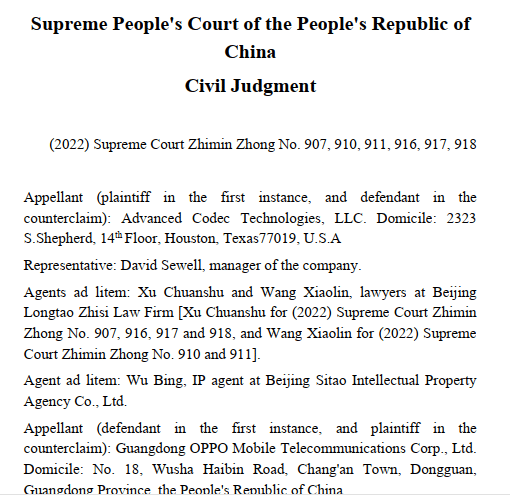
Summary: This post covers the decision of the Supreme People’s Court of China’s decision in the case of Advanced Codec Technologies, LLC v. Guangdong OPPO Mobile Telecommunications Corp., Ltd. (Case Nos. (2022) Zhimin Zhong 907, 910, 911, 916, 917, 918, decided on December 12, 2023) addresses a complex dispute over Fair, Reasonable And Non-Discriminatory (FRAND) terms for Standard Essential Patents (SEPs).
This case involves six patents related to the Adaptive Multi-Rate Wideband (AMR-WB) standard, critical for broadband audio signal processing in mobile communications. The plaintiff, Advanced Codec Technologies, LLC (Advanced Codec), a U.S.-based company, alleged that OPPO, a major Chinese smartphone manufacturer, infringed these patents by incorporating them into 44 mobile phone models without a license. The case also involved Nanjing Baixia Suning.com Trading Co., Ltd., a retailer, but the primary focus was the royalty dispute between Advanced Codec and OPPO. This summary provides a detailed analysis of the decision, with a particular emphasis on how the court computed the royalty owed to the patent holder.
The case originated in the Intermediate People’s Court of Nanjing, which issued judgments on November 22, 2021, ordering OPPO to pay royalties totaling RMB 13.06 million for the six patents. Both parties appealed, leading to the Supreme People’s Court’s review. Advanced Codec sought RMB 57 million per patent, alleging OPPO’s deliberate delay in licensing negotiations, while OPPO contested the royalty calculations and argued that Advanced Codec violated Fair, Reasonable, and Non-Discriminatory (FRAND) principles.
The Supreme Court upheld some aspects of the first-instance judgment but significantly revised the royalty computation, ultimately ordering OPPO to pay RMB 15,390,527 in royalties, plus interest and RMB 600,000 in reasonable expenses.
The decision clarifies SEP royalty calculations in China, emphasizing the comparable agreements method and the importance of FRAND compliance. By selecting a single, contextually relevant agreement (Company B Agreement 1), the court ensured a market-based royalty rate. The equal fault allocation underscores the need for good-faith negotiations, penalizing tactics like litigation threats or opaque pricing.
The ruling also highlights the distinction between SEP and non-SEP infringement, focusing on contractual negligence rather than unilateral fault. This approach aligns with global SEP jurisprudence, balancing patent holders’ rights with implementers’ access to essential technologies. For Advanced Codec, the RMB 15,390,527 award, plus interest and expenses, was significantly less than the RMB 342 million sought, reflecting the court’s conservative royalty assessment.
In conclusion, the Supreme People’s Court’s royalty computation in this case demonstrates a rigorous, evidence-based approach, prioritizing comparable agreements, accurate sales data, and equitable fault allocation. This decision serves as a precedent for SEP disputes in China, reinforcing FRAND principles and judicial oversight in licensing negotiations.
Thoughts in June 2025
The Advanced Codec v. OPPO decision is a landmark in SEP litigation, offering a rigorous, balanced approach to royalty computation and fault allocation. Its emphasis on comparable agreements and shared responsibility contrasts with the pro-patentee leanings of UK, German/UPC, and Indian courts, which often grant patentee requests with less scrutiny. By providing a transparent, market-based methodology, the decision mitigates conflicts of laws and promotes comity, serving as a model for global SEP adjudication in June 2025. Other courts would benefit from adopting its viewpoints to ensure fair, consistent, and FRAND-compliant outcomes, reducing fragmentation in the global patent landscape.
Why Other Courts Should Consider This Approach:
Given the decision’s rigorous grounding, it offers several advantages:
Objectivity in Royalty Setting: The comparable agreements method, with clear selection criteria (PAGE49), ensures royalties reflect market realities rather than patentee demands. UK and Indian courts, which often rely on patentee submissions, could adopt this to prevent inflated awards.
Equitable Fault Assessment: The court’s detailed analysis of negotiation faults (PAGE35–PAGE37) holds both parties accountable, unlike Germany’s implementer-focused scrutiny. This promotes FRAND compliance and discourages strategic litigation. Unlike other litigation, SEP litigation is strategic: it is designed to shock and awe the implementor–examples are multi-jurisdictional cases brought in a short time frame of matter of weeks or often simultaneous filings.
Alignment with Industry Practices: Treating SEPs as a bundle and using lump-sum royalties (PAGE39) mirrors industry norms, providing predictability. The UPC, aiming to standardize European patent litigation, could benefit from this approach to align with global markets.
Reducing Conflict and Forum Shopping: By offering a transparent, market-based framework, the decision discourages patentees from seeking favorable jurisdictions, as seen in UK or German courts, fostering global consistency.
Relevance in June 2025
In June 2025, the global SEP landscape is increasingly complex, with 5G technologies driving new disputes and the UPC establishing its authority. The Chinese decision’s relevance persists because:
Growing SEP Litigation: As 5G SEPs face similar FRAND disputes, the Chinese approach provides a scalable model for royalty disputes, applicable across technologies such as 5G patents or codecs.
China’s Role in Global Tech: China’s status as a major telecom market, production center and patent jurisdiction makes its SEP rulings influential. The Advanced Codec decision, issued by the Supreme People’s Court, carries weight as a precedent for handling high-stakes disputes.
Countering Pro-Patentee Bias: The decision’s balanced approach counters the pro-patentee tilt in other jurisdictions, encouraging courts to prioritize fairness and evidence over expediency.
Harmonizing Jurisprudence: As courts grapple with cross-border SEP issues, the Chinese framework offers a path to harmonize royalty calculations and fault assessments, reducing conflicts and enhancing comity.
How can comity be enhanced (as seen from this decision)
International comity—the mutual respect for foreign judicial decisions—is critical in SEP cases due to their global impact. The pro-patentee trends in the UK, Germany/UPC, and India risk undermining comity by prioritizing patentee interests, potentially forcing implementers to accept high royalties or face injunctions across jurisdictions. This can lead to “forum shopping,” where patentees seek favorable venues, exacerbating global legal fragmentation. Ultimately, this is a loss for consumers in one jurisdiction as implementors will not ‘eat‘ the higher costs – they will simply pass it on to the consumers.
Balanced Adjudication: By holding both parties accountable for negotiation failures, the court avoids the pro-patentee bias seen in other jurisdictions. This neutrality encourages foreign courts to view Chinese SEP rulings as fair and worthy of deference.
Precedential Value: The decision’s detailed reasoning on comparable agreements and fault allocation (PAGE29–PAGE40) provides a model for transparent adjudication. For example, the UPC, still developing its SEP jurisprudence in 2025, could adopt similar criteria to ensure consistency with Chinese rulings, fostering mutual respect.
Avoiding Overreach: Unlike UK courts setting global rates, the Chinese court limited its royalty calculation to China-specific use (PAGE29), respecting other jurisdictions’ sovereignty. This restraint contrasts with German courts’ broad injunctions, which may conflict with foreign rulings.
Downloads
The Decision’s Approach: A Rigorous, Balanced Framework
- Comparable Agreements Method:
- The Chinese court adopted the comparable agreements method to calculate royalties, selecting the March 19, 2020, agreement with Company B (USD 6 million for 760,416,171 devices, yielding a unit royalty rate of USD 0.007890416, adjusted to USD 0.008/unit). This method required careful selection of agreements based on factors like voluntary negotiation, similarity of licensing entities, licensed patents, and terms (Judgment, PAGE49). The court rejected less comparable agreements (e.g., Company A’s global license under litigation pressure), ensuring the royalty reflected market realities.
- This approach contrasts with UK, German, and Indian courts, which often accept patentee-proposed royalty rates without rigorous benchmarking. For instance, in Unwired Planet, the UK court set a global rate based on patentee submissions, with less emphasis on comparable agreements’ context.
- Fault Allocation and FRAND Compliance:
- The court meticulously assessed both parties’ negotiation conduct, finding Advanced Codec and OPPO equally at fault (50% each) for failing to reach a licensing agreement (PAGE37–PAGE38). Advanced Codec’s faults included opaque royalty calculations and litigation threats, while OPPO’s included withholding sales data and low counter-offers without justification. This shared fault led to a 50% allocation of interest losses (2.125% annual rate from September 20, 2019).
- Unlike UK and German courts, which often penalize implementers for rejecting patentee offers (e.g., Sisvel v. Haier), the Chinese court’s balanced fault assessment ensures neither party is disproportionately favored, aligning with FRAND’s good-faith negotiation requirement.
- Royalty Calculation and Interest Losses:
- The court calculated a total royalty of RMB 15,390,527 (USD 2,176,878 for 272,109,806 units at USD 0.008/unit), treating the six patents as a single bundle, reflecting industry practice (PAGE40). It added interest losses to compensate for delayed payment, assuming a reasonable negotiation period of 18 months (PAGE39). This contrasts with the first-instance court’s per-patent allocation, which the Supreme Court corrected for simplicity and industry alignment.
- Other jurisdictions, like India in recent cases (2015: Interim order; 2022/2023: Pro Tem), often impose interim royalties based on patentee estimates without such detailed market-based calculations, potentially inflating awards.
Basis for Determination of Royalties (Summarized & Key Parts Highlighted)
Procedural History: The case originated in the Intermediate People’s Court of Nanjing, which issued judgments on November 22, 2021, ordering OPPO to pay royalties totaling RMB 13.06 million for the six patents. Both parties appealed, leading to the Supreme People’s Court’s review. Advanced Codec sought RMB 57 million per patent, alleging OPPO’s deliberate delay in licensing negotiations, while OPPO contested the royalty calculations and argued that Advanced Codec violated FRAND principles. The Supreme Court upheld some aspects of the first-instance judgment but significantly revised the royalty computation, ultimately ordering OPPO to pay RMB 15,390,527 in royalties, plus interest and RMB 600,000 in reasonable expenses.
Background and Legal Framework
The six patents, collectively referred to as the “Six Patents Involved,” cover technologies essential to the Adaptive Multi Rate- Wide Band (AMR-WB) standard, used in mobile devices supporting Voice over LTE (VoLTE). These patents were originally filed by VoiceAge Corporation and transferred to St. Lawrence Communications LLC, which granted Advanced Codec an exclusive license to enforce and litigate them. The dispute centered on whether OPPO’s 44 mobile phone models infringed these patents and what royalties were owed, given the SEPs’ obligation to be licensed under FRAND terms.
The Supreme Court applied Chinese law, including the Civil Code and the Patent Law (as amended in 2008), to govern the dispute, classifying it as a contractual negligence case due to the failure to reach a licensing agreement. The court emphasized that SEPs differ from non-SEPs because they must be licensed under FRAND terms, creating a reasonable reliance by implementers like OPPO. This framework shaped the royalty computation, focusing on fairness, the parties’ negotiation conduct, and comparable licensing agreements.
Key Issues in Royalty Computation
The court identified three main issues in determining the royalty: (1) the sales volume of the allegedly infringing mobile phones, (2) the unit royalty rate, and (3) the degree of fault of both parties in the licensing negotiations. These factors were critical to calculating the principal royalty amount and any additional interest due to delays caused by negotiation failures.
Sales Volume Determination
The court relied on sales data from the International Data Corporation (IDC) to establish the number of OPPO’s infringing mobile phones sold. Advanced Codec provided evidence showing sales of 272,109,806 units from Q3 2015 to Q4 2020. The court accepted this figure, noting that OPPO did not provide contradictory evidence. Advanced Codec claimed 270 million units by Q2 2021, but the court rejected this due to lack of specific data for 2021 and inconsistencies in new model claims.
OPPO argued that 12 models launched before 2017 did not support VoLTE, as domestic operators did not require it, but the court inferred that all 44 models likely included VoLTE-supporting chips, especially after the YD/T 3178-2016 standard was implemented in 2017. Thus, the court used 272,109,806 units as the basis for royalty calculations, ensuring the sales period aligned with the patents’ validity (the last patent expired in November 2021).
Unit Royalty Rate Calculation
The court adopted the “comparable agreements method” to determine the unit royalty rate, emphasizing the need to select agreements that reflect voluntary negotiations, similar licensing entities, licensed patents, and terms. The court evaluated several agreements submitted by Advanced Codec, ultimately selecting the March 19, 2020, agreement with Company B (Company B Agreement 1) as the most comparable.
Company B Agreement 1 licensed the Six Patents Involved for use in China, with a royalty of USD 6 million for 760,416,171 devices. The court calculated the unit royalty rate as USD 0.007890416 (USD 6 million ÷ 760,416,171 units). Adjusting for OPPO’s context, the court set the unit royalty rate at USD 0.008 per unit, rejecting the first-instance court’s inclusion of three AMR-WB+ patents in the calculation, which had inflated the denominator and reduced the rate to USD 0.005260277.
The court dismissed other agreements, such as those with Company A and Company C, due to differences in licensing scope (e.g., worldwide vs. China-only) and negotiation context (e.g., litigation pressure). For instance, Company A’s agreement involved a global license and was influenced by a pending lawsuit, making it less comparable. Company C’s agreement covered fewer devices (37,315,005 units) and was signed amid U.S. and German lawsuits, reducing its relevance. The court’s focus on Company B Agreement 1 ensured a rate grounded in a similar market and negotiation environment.
Fault in Licensing Negotiations
The court found both parties equally at fault (50% each) for failing to reach a licensing agreement, impacting the allocation of interest losses. Advanced Codec initiated negotiations in February 2018, proposing royalties of USD 0.2–0.4 per unit, later specifying USD 0.26/unit (USD 189,055,000 total). OPPO responded positively but countered with RMB 3.7 million, later USD 1 million, which Advanced Codec deemed unreasonably low. Negotiations continued through 2020 but stalled due to mutual distrust.
Advanced Codec’s faults included failing to explain its royalty calculations (e.g., USD 189,055,000, USD 17 million, USD 8 million) and repeatedly threatening litigation (seven times in 2018), creating a coercive atmosphere. OPPO failed to disclose sales data despite a confidentiality agreement and offered low counter-offers without detailed justification, undermining trust. The court ruled that these faults caused the delay in concluding a license, justifying shared responsibility for interest losses.
Final Royalty Computation
The court calculated the total royalty as USD 2,176,878 (272,109,806 units × USD 0.008/unit), equivalent to RMB 15,390,527 at the September 20, 2019, exchange rate (RMB 7.07/USD). Unlike the first-instance court, which allocated royalties per patent based on their expiration dates, the Supreme Court treated the Six Patents as a single licensing bundle, reflecting industry practice of blanket licenses paid upfront.
The court added interest losses to account for the delay in payment, assuming a licensing agreement could have been reached by September 20, 2019 (18 months after OPPO’s March 14, 2018, response). Interest was calculated at 4.25% (the one-year loan prime rate on August 20, 2019), with OPPO liable for 50% (2.125%) from September 20, 2019, until payment. This approach recognized Advanced Codec’s loss of timely royalty benefits due to negotiation failures.
Additionally, the court upheld RMB 600,000 in reasonable expenses for Advanced Codec’s efforts to investigate and stop the infringement, consistent with the first-instance ruling. The court rejected Advanced Codec’s claim for triple damages, finding no basis for punitive multipliers under SEP disputes, and dismissed OPPO’s counterclaims, including its request for RMB 1 million in losses, due to insufficient evidence.
Legal and Practical Implications
The decision clarifies SEP royalty calculations in China, emphasizing the comparable agreements method and the importance of FRAND compliance. By selecting a single, contextually relevant agreement (Company B Agreement 1), the court ensured a market-based royalty rate. The equal fault allocation underscores the need for good-faith negotiations, penalizing tactics like litigation threats or opaque pricing.
The ruling also highlights the distinction between SEP and non-SEP infringement, focusing on contractual negligence rather than unilateral fault. This approach aligns with global SEP jurisprudence, balancing patent holders’ rights with implementers’ access to essential technologies. For Advanced Codec, the RMB 15,390,527 award, plus interest and expenses, was significantly less than the RMB 342 million sought, reflecting the court’s conservative royalty assessment.
In conclusion, the Supreme People’s Court’s royalty computation in this case demonstrates a rigorous, evidence-based approach, prioritizing comparable agreements, accurate sales data, and equitable fault allocation. This decision serves as a precedent for SEP disputes in China, reinforcing FRAND principles and judicial oversight in licensing negotiations.