
Summary: In July 2023, a Division Bench ofthe Delhi High Court had in the appeal filed by Oppo against Nokia, held that a single judge could issue pro tem orders mandating security deposits for securing the interests of the patentee during the time the litigation persists. Oppo appealed to the Supreme Court of India, but the same was dismissed. This dismissal may have had an overall impact in Oppo’s decision to settle shortly thereafter. This post is not about the Indian case law but about its counterpart in China.
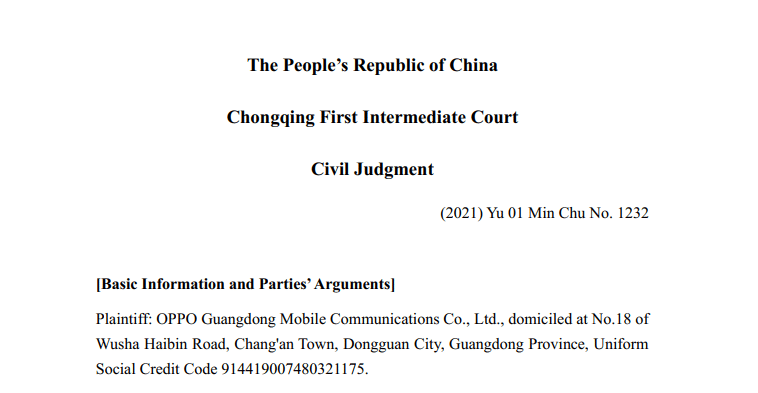
This post covers the decision issued by a Chinese Court in a case filed by Oppo against Nokia | Case No. (2021) Yu 01 Min Chu No. 1232. The decision can be downloaded from the blog directly (click on the Civil Judgement or download from below). This post looks at the decision of the Chinese Court from a conflict of law perspective and focusses on the determination of factors influencing royalty payment / Fair, Reasonable And Non-Discriminatory (FRAND) terms for Standard Essential Patents (SEP).
It is generally seen that Courts in India, many jurisdictions in Europe including Germany, Netherlands, etc., UK have in recent times given decisions favouring the patentee including pro tem measures, injunctions, etc. that literally force the implementor to settle even before a basic trial has been done on validity, essentiality and infringement. At times, these decisions either ignore or outrighly over-rule the decision of the Chinese Courts.
In my view, this over-ruling or ognoring reasoned decisions by a court having jurisdiction / or over-ruling them, is against the basic principles of comity and good faith: A patent is a jurisidictional creature and granted by each jurisdiction–there is no global patent. And it is not as if an SEP is always registered only in a single country: it is usually registered in multiple jurisdictions. So each of these courts have a right to rule upon these SEPs. (Note that I am not even going into the fact whether a SEP is registered in most or some or a select few jurisdictions). Given that Chinese implementors are fast becoming patent owners, it is time that other jurisdictions give parity to parties and not place the patent owner on a pedestal.
The decision by the Chinese Court is illuminating in multiple ways including reaching to the conclusion of what is FRAND for a mobile device and can be extended to any particular device using standards.
Application of Law and Basis of (its) Application
- Civil Code of the People’s Republic of China (PRC), Articles 5, 6, and 7, which outline general principles of civil law, including fairness, good faith, and compliance with legal norms.
- Interpretation of the Supreme People’s Court on Several Issues Concerning the Application of Law in the Trial of Patent Infringement Dispute Cases (2), Paragraph 3, Article 24, which addresses the handling of standard-essential patent (SEP) disputes and FRAND (Fair, Reasonable, and Non-Discriminatory) licensing obligations.
- Law of the People’s Republic of China on the Application of Laws in Foreign-Related Civil Relations, Articles 41, 49, and 50, which govern the choice of law in foreign-related civil disputes.
- Civil Procedure Law of the PRC, Paragraph 1, Article 67, and Article 145, which regulate evidence and procedural matters in civil litigation.
- Foreign-Related Nature of the Case: The case involved foreign parties (Nokia Corporation and Nokia Technologies Oy, both Finnish entities) and a Chinese entity (Nokia Technologies (Beijing) Co., Ltd.), as well as global licensing negotiations. The court applied foreign-related civil procedures under the Law on the Application of Laws in Foreign-Related Civil Relations.
- Party Autonomy and Contractual Context: The court noted that the parties had not explicitly agreed on a governing law for the 2021 OPPO Agreement in their negotiations. In the absence of a chosen law, Chinese law was applied as the default, consistent with Article 41 of the Law on the Application of Laws in Foreign-Related Civil Relations, which allows the court to apply the law of the jurisdiction with the closest connection to the dispute. Since the plaintiffs (OPPO entities) are Chinese companies, the dispute was adjudicated in a Chinese court, and the case involved SEPs with significant implementation in China, Chinese law was deemed appropriate.
- FRAND Obligations and Chinese Jurisdiction: The court emphasized that Nokia’s SEPs were subject to FRAND obligations under the policies of the European Telecommunications Standards Institute (ETSI) and commitments made to China’s Ministry of Commerce in 2014 and 2015. These commitments reinforced the applicability of Chinese law to ensure compliance with FRAND principles, particularly as the dispute involved determining global royalty rates for SEPs used in China and worldwide.
- Judicial Precedent and Policy: The court referenced prior Chinese judicial decisions (e.g., Huawei v. Conversant) to support its application of Chinese law in SEP disputes, reinforcing the use of domestic legal frameworks for interpreting FRAND obligations and royalty calculations.
The court rejected the defendants’ jurisdictional objections, and the Supreme People’s Court upheld this ruling (See decision affirming the Chongqing court’s authority to determine global FRAND licensing conditions under Chinese law.
Basis for Determination of Royalties (Summarized & Key Parts Highlighted)
Key Methodologies
Comparable License Approach:
Primary Agreement: The court primarily relied on the 2018 OPPO Agreement as a comparable agreement to calculate 4G royalty rates, as both parties agreed on its comparability. The agreement was unpacked to derive a one-way royalty for Nokia’s patents, adjusted for discounts and expected sales volumes. Unpacking Process: The court calculated Nokia’s one-way royalty by adding the net payment (redacted amount) and a discount (redacted amount) from the 2018 OPPO Agreement. Expected sales volumes were determined based on negotiation emails, with the court adopting Nokia’s proposed sales volume of [REDACTED] units annually for [REDACTED] years. Changes in Nokia’s 4G patent strength between the 2018 and 2021 agreements were factored in, using a comparative ratio of [REDACTED] based on third-party reports (Concur IP and Moqiu).Regional Division: The court adopted OPPO’s three-region division (Region 1: countries with per capita GDP ≥ $20,000; Region 2: mainland China; Region 3: other countries), applying a 61.42% discount to Regions 2 and 3, based on Nokia’s patent deployment data (e.g., 6.8% of patent families issued in China vs. 10.3% in the US and 13.2% in Europe) and regional economic differences.
Royalty Base: The court used the net selling price (NSP) as the royalty base, rejecting Nokia’s proposed retail price (average selling price, ASP). NSP excludes costs like packaging, insurance, transportation, taxes, and other fees, aligning with foreign judicial practices and prior agreements (e.g., Nokia-Wavecom, Nokia-SONIM).
Result for 4G: The court calculated 4G multi-mode mobile phone royalty rates as: Region 1: [REDACTED]% ($0.777/unit) || Regions 2 and 3: [REDACTED]% ($0.477/unit)Top-Down Approach (for 5G):
Formula: The court adopted OPPO’s top-down formula: Nokia’s 5G royalty rate = (5G global aggregate royalty rate × Nokia’s 5G patent strength × 5G value share) + (4G aggregate rate × 4G patent strength × 4G value share) + (3G aggregate rate × 3G patent strength × 3G value share) + (2G aggregate rate × 2G patent strength × 2G value share). Global Aggregate Royalty Rates: 2G: 5% | 3G: 5% | 4G: 6–8% (based on judicial precedents like Huawei v. Conversant and Nokia’s public statements estimating 4G aggregate rates at 5–7.5%) ||5G: 4.341–5.273% (calculated using a hedonic price regression model, assessing 5G’s value contribution relative to 4G, based on Canalys data). Nokia’s Patent Strength: Determined by the share of Nokia’s declared SEPs (including patent applications) relative to total SEPs, based on third-party data (e.g., Questel report). Shares were [REDACTED] for 2G, 3G, 4G, and 5G, respectively. The court rejected Nokia’s proposal to use issued patents or contributions, citing the inclusion of patent applications in negotiations and the lack of evidence for superior patent quality. Value Contribution Shares: The court adopted a 50:40:5:5 ratio for 5G:4G:3G:2G, based on judicial precedents (e.g., Huawei v. Conversant’s 8:1:1 for 4G:3G:2G) and evidence suggesting limited additional value of 5G over 4G in smartphones during the early adoption phase. Result for 5G: The court calculated 5G multi-mode mobile phone royalty rates using both the top-down and comparable license approaches, adopting the latter (more favorable to Nokia) as: Region 1: [REDACTED]% ($1.151/unit) || Regions 2 and 3: [REDACTED]% ($0.707/unit) Cross-Check: The court rejected OPPO’s unpacking of the Huawei Agreement for cross-checking, as additional agreements (redacted) complicated the analysis. The Xiaomi Agreement was also deemed incomparable due to insufficient negotiation evidence and differences in business models.Key Considerations
FRAND Principles: The court ensured royalties complied with FRAND obligations, rejecting Nokia’s allegedly excessive offers and litigation tactics (e.g., filing injunctions in multiple jurisdictions) as violations of good faith. Negotiation Context: The court considered negotiation emails to unpack the 2018 OPPO Agreement, ensuring rates reflected the parties’ true intentions. Patent Strength Adjustments: Changes in Nokia’s patent strength were accounted for, using third-party data to adjust rates between 2018 and 2021. Regional Discounts: The 61.42% discount for Regions 2 and 3 was justified by Nokia’s lower patent deployment in China and economic disparities. Net Present Value (NPV): The court rejected NPV adjustments, as the agreements (including the 2018 OPPO Agreement) were not long-term, and negotiation evidence did not support NPV considerations.Final Royalty Rates
Notes about the numbers
Redacted Information: Key figures (e.g., exact royalty rates, sales volumes, discounts) are redacted, limiting calculations. The court’s final dollar-per-unit rates ($0.777 and $0.477 for 4G, $1.151 and $0.707 for 5G) were explicitly stated and used to infer other parameters. This is a guesstimate and need not be accurate. Nokia Beijing’s Role: The court upheld Nokia Beijing as a defendant, citing its participation in 2021 OPPO Agreement negotiations, despite not being a patentee. Litigation Costs: Nokia was ordered to bear the court fee of 1,000 yuan, reflecting OPPO’s partial success.Economic Principles Used in the Decision
-
FRAND Principles: The court ensured royalty rates were fair and reasonable, aligning with Nokia’s FRAND obligations under ETSI policies and commitments to China’s Ministry of Commerce. This principle required balancing the value of Nokia’s SEPs with OPPO’s right to access them without excessive pricing or discriminatory terms.
-
Comparable License Approach: This principle involves using existing license agreements (e.g., the 2018 OPPO Agreement) as benchmarks to derive royalty rates, assuming they reflect market-based negotiations. The court unpacked these agreements to isolate Nokia’s one-way royalty, adjusting for factors like discounts, sales volumes, and patent strength changes.
-
Top-Down Approach: This approach estimates royalties by allocating a portion of an industry-wide aggregate royalty rate to a patent holder based on their share of SEP strength and the value contribution of each standard (2G, 3G, 4G, 5G). It aims to prevent royalty stacking (cumulative royalties exceeding reasonable limits) and ensure proportionality.
-
Hedonic Price Regression: Used to estimate the value contribution of 5G technology relative to 4G, this econometric model analyzes price differences between 4G and 5G mobile phones, controlling for other factors (e.g., brand, region, time). It informed the 5G aggregate royalty rate calculation.
-
Patent Strength Assessment: The court measured Nokia’s SEP strength by the share of declared patents (including applications) relative to total SEPs, assuming equal patent quality in large samples unless evidence suggests otherwise. This principle underpinned both the top-down and comparable license approaches.
-
Regional Economic Differentiation: The court applied regional discounts (61.42% for China and other developing regions) based on economic disparities and Nokia’s patent deployment patterns, reflecting the principle that patent value varies by market.
-
Net Selling Price (NSP) as Royalty Base: The court used NSP (excluding costs like taxes, transportation, and packaging) to avoid overcompensating Nokia by including non-patent-related value (e.g., brand, design), aligning with economic fairness.
-
Value Contribution Weighting: The court assigned value contribution shares to different standards (50:40:5:5 for 5G:4G:3G:2G) to reflect their relative importance in multi-mode mobile phones, ensuring royalties matched technological impact.
-
Avoidance of Net Present Value (NPV) Adjustments: The court rejected NPV adjustments for short-term agreements, prioritizing the parties’ negotiation intent over speculative discount rates, reflecting a principle of minimizing arbitrary assumptions.
Comparison and Contrast of OPPO’s and Nokia’s Economic Approaches
- Comparable License Approach (4G and 5G):
- Benchmark: OPPO used the 2018 OPPO Agreement to derive 4G royalty rates, unpacking it to calculate Nokia’s one-way royalty ([REDACTED] USD + [REDACTED] USD discount). Expected sales volumes were based on negotiation emails ([REDACTED] units annually for [REDACTED] years).
- Adjustments: OPPO adjusted for changes in Nokia’s 4G patent strength ([REDACTED] ratio) using third-party reports (Concur IP, Moqiu). For 5G, OPPO combined 4G rates with 5G value contribution estimates (50:50 ratio with 4G multi-mode technology) and a 5G single-mode rate derived from Nokia’s patent strength and industry aggregate rate.
- Regional Division: OPPO proposed a three-region division (Region 1: high-income countries; Region 2: China; Region 3: others), with a 61.42% discount for Regions 2 and 3, based on Nokia’s patent deployment (e.g., 6.8% of patent families in China vs. 10.3% in the US) and economic disparities.
- Royalty Base: OPPO used NSP, excluding non-patent costs, aligning with prior agreements and foreign judicial practices.
- Cross-Check: OPPO attempted to unpack the Huawei Agreement for validation, but the court rejected this due to additional agreements complicating the analysis.
- Top-Down Approach (5G):
- Formula: Nokia’s 5G royalty = (5G aggregate rate × Nokia’s 5G patent strength × 5G value share) + (4G aggregate rate × 4G patent strength × 4G value share) + (3G and 2G contributions). Aggregate rates were 5% for 2G and 3G, 6–8% for 4G, and 4.341–5.273% for 5G (via hedonic regression).
- Patent Strength: Calculated as Nokia’s share of declared SEPs ([REDACTED] for 2G, 3G, 4G, 5G), using third-party data (e.g., Questel’s report on 5G essentiality).
- Value Shares: OPPO proposed a 50:40:5:5 ratio for 5G:4G:3G:2G, citing limited 5G value in smartphones and precedents (e.g., Huawei v. Conversant).
- Data Sources: OPPO relied on Canalys for sales data, Questel for patent essentiality, and Concur IP/Moqiu for patent strength, emphasizing third-party neutrality.
- Economic Tools:
- Hedonic Price Regression: Estimated 5G’s value contribution by comparing 4G and 5G phone prices, controlling for time, manufacturer, and country effects.
- Statistical Averaging: Used multiple databases to reduce single-source bias in patent strength calculations.
- Conservative Assumptions: Assumed all licensed products were sold in discounted regions (Regions 2 and 3) for 4G calculations, favoring Nokia.
- Comparable License Approach (4G and 5G):
- Benchmarks: Nokia emphasized the [REDACTED] Xiaomi Agreement as the most comparable, alongside the 2018 OPPO Agreement. It unpacked these to derive royalty rates, assuming [REDACTED] terms reflected market conditions.
- Adjustments: Nokia applied NPV discounts ([REDACTED]% annual rate) to account for payment timing, which OPPO and the court rejected. It also proposed a two-region division (China vs. rest of the world) with a [REDACTED]% discount for China, arguing it was the negotiation floor.
- Royalty Base: Nokia advocated for retail price (ASP), claiming it was equivalent to NSP, which the court rejected as it included non-patent value.
- Calculations: Nokia’s 4G rates were [REDACTED]–[REDACTED] USD/unit in China and [REDACTED]–[REDACTED] USD/unit elsewhere. For 5G, rates were [REDACTED] USD/unit in China and [REDACTED] USD/unit elsewhere, with lump-sum royalties of [REDACTED]–[REDACTED] hundred million USD for OPPO brands.
- Rejection of Top-Down Approach:
- Nokia argued that royalty stacking (the rationale for the top-down approach) was a “false proposition” without empirical evidence. It claimed comparable agreements were sufficient, rendering the top-down approach unnecessary.
- Nokia challenged OPPO’s 5G aggregate rate (4.341–5.273%), arguing 5G’s value exceeded 4G’s, and questioned the hedonic regression’s data (Canalys), sample periods, and lack of weighting or Kennedy transformation.
- Patent Strength:
- Nokia proposed assessing patent strength via issued patents, approved contributions, and technical leadership (e.g., working group chairs), rather than declaration shares. It claimed its SEPs were of above-average quality but provided no specific adjustments.
- Economic Tools:
- NPV Analysis: Applied discount rates to adjust for payment timing, assuming long-term financial considerations.
- Industry Reports: Relied on IDC data and internal analyses, challenging Canalys’ neutrality and Moqiu’s credibility.
- Negotiation-Based Assumptions: Nokia inferred key data (e.g., [REDACTED] in Xiaomi Agreement) from industry reports, lacking direct negotiation evidence.
Comparison and Contrast
- Methodological Scope:
- OPPO: Used both comparable license and top-down approaches, providing a dual framework for robustness. The top-down approach addressed royalty stacking, while the comparable approach grounded rates in prior agreements.
- Nokia: Focused solely on the comparable license approach, rejecting the top-down approach as unnecessary and unsupported by evidence of royalty stacking. This narrower scope limited flexibility.
- Data and Evidence:
- OPPO: Relied on third-party data (Canalys, Questel, Concur IP, Moqiu) and judicial precedents (e.g., Huawei v. Conversant). It used multiple databases to average patent strength, reducing bias, and provided detailed hedonic regression analysis for 5G rates.
- Nokia: Used IDC data and internal reports, but lacked negotiation evidence for the Xiaomi Agreement, relying on ex-post inferences. Its challenge to OPPO’s data (e.g., Canalys) was deemed speculative by the court.
- Regional Division:
- OPPO: Proposed a three-region model with a 61.42% discount for China and developing regions, supported by Nokia’s patent deployment data and economic disparities.
- Nokia: Advocated a two-region model with a [REDACTED]% discount for China, arguing it reflected negotiation norms, but the court found this insufficiently justified.
- Royalty Base:
- OPPO: Used NSP, aligning with industry practices and excluding non-patent value, supported by prior Nokia agreements.
- Nokia: Used ASP, claiming equivalence with NSP, but the court rejected this as it inflated royalties by including non-patent costs.
- Patent Strength:
- OPPO: Measured strength by declaration shares, assuming equal quality in large samples, with third-party validation (e.g., Questel’s essentiality rate).
- Nokia: Proposed multi-dimensional metrics (issued patents, contributions), but lacked quantitative adjustments, weakening its position.
- Court’s Preference:
- The court favored OPPO’s approach for its rigor, reliance on neutral third-party data, and alignment with judicial precedents. OPPO’s dual methodology allowed cross-checking, enhancing credibility. Nokia’s approach was criticized for lacking negotiation evidence (e.g., Xiaomi Agreement), applying unsupported NPV discounts, and making speculative assumptions.
Conclusion
Key Takeaways
- Strengths:
- Economic Rigor: The primary strength of this decision is the adoption of hedonic regression and dual methodologies to set a high standard for FRAND calculations; this is transparent and is based on the value of the patent and not the standard. More importantly, this method even though applied on the selling price, results in linking the value of the standard to the product.
- Jurisdictional Boldness: At the time it issued, it set global rates under Chinese law and reinforced China’s role in SEP disputes. However, other jurisdictions quickly started to give their own global FRAND rate determinations.
- FRAND Compliance: The rates balanced Nokia’s innovation with OPPO’s market access.
- Weaknesses:
- Redacted Data: This is applicable only to other parties as key figures (e.g., patent strength ratios) were obscured, limiting transparency. If the data is made public, then it is easier for implementors to adopt the standard. I argue that SEPs and FRAND rates should be public–as they find their rationale in public interest.
- Conservative 5G Valuation: The 5G rate may undervalue future contributions at a rate that is lower than what other jurisdictions are able to give out. For example, the value from Europe vs. value from China. But this too, can be resolved if more data is made available.
- Patent Strength Simplification: Assuming equal SEP quality risks inaccuracies. This is a problem globally and needs to be addressed. However, if entire portfolios are taken up in one go, then there has to be a simplified approach.