
Summary: In 2018, the Indian Supreme Court delivered a judgment striking down the Sabarimala Temple’s age-old practice of restricting the entry of women aged 10-50. However, the legal and philosophical debate did not end with that verdict.
The 2026 Sabarimala Review and the Quest to Restore Denominational Autonomy
In 2018, a five-judge bench of the Supreme Court delivered a deeply contested judgment striking down the Sabarimala Temple’s ancient tradition of restricting the entry of women aged 10-50. For the devotees of Lord Ayyappa and the review petitioners, this verdict represented a severe judicial encroachment upon the autonomy of religious denominations and a misapplication of fundamental rights. However, the legal and philosophical battle is far from over.
Following a 2020 decision that conclusively upheld the Court’s power to refer questions to a larger bench while exercising its review jurisdiction, the Supreme Court has now constituted a Nine-Judge Bench to reconsider the fundamental tenets of religious freedom.
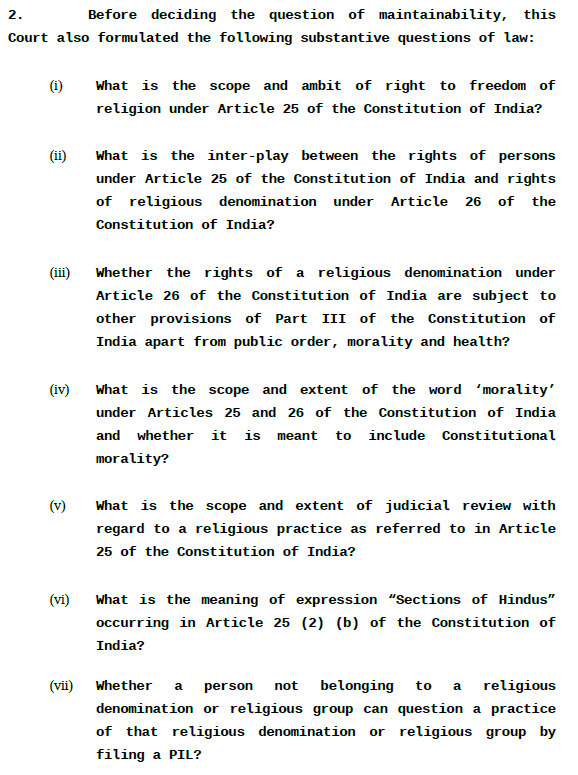
In its recent order dated February 16, 2026 , the Court formulated seven substantive questions of law with a view to finally lay this issue to rest. For the review petitioners, these seven questions cut to the very core of India’s secular fabric and offer a historic opportunity to rectify the 2018 majority’s doctrinal overreach. Crucially, the Nine-Judge Bench will determine whether a person not belonging to a religious denomination or group can even question its practices through a Public Interest Litigation (PIL) —a direct challenge to the “interlopers” who initiated the original 2018 case.
Furthermore, the Court is set to adjudicate the proper scope of judicial review over religious practices under Article 25 , the true extent of “morality” under Articles 25 and 26 , and whether the protective rights granted to a religious denomination under Article 26 are entirely subjugated to other provisions of Part III of the Constitution.
As the hearings for the review petitioners are set to commence today (April 7, 2026), this post argues that these substantive questions must be answered by elevating Justice Indu Malhotra’s powerful 2018 dissent. Only by firmly demarcating the interplay between individual rights under Article 25 and denominational rights under Article 26 can the Supreme Court protect minority religious practices from being rationalized out of existence by secular courts.
Justice Indu Malhotra
Dissent
“16. The summary of the aforesaid analysis is as follows:
(i) The Writ Petition does not deserve to be entertained for want of standing. The grievances raised are non-justiciable at the behest of the Petitioners and Intervenors involved herein.
(ii) The equality doctrine enshrined under Article 14 does not override the Fundamental Right guaranteed by Article 25 to every individual to freely profess, practise and propagate their faith, in accordance with the tenets of their religion.
(iii) Constitutional Morality in a secular polity would imply the harmonisation of the Fundamental Rights, which include the right of every individual, religious denomination, or sect, to practise their faith and belief in accordance with the tenets of their religion, irrespective of whether the practise is rational or logical.
(iv) The Respondents and the Intervenors have made out a plausible case that the Ayyappans or worshippers of the Sabarimala Temple satisfy the requirements of being a religious denomination, or sect thereof, which is entitled to the protection provided by Article 26. This is a mixed question of fact and law which ought to be decided before a competent court of civil jurisdiction.
(v) The limited restriction on the entry of women during the notified age-group does not fall within the purview of Article 17 of the Constitution.
(vi) Rule 3(b) of the 1965 Rules is not ultra vires Section 3 of the 1965 Act, since the proviso carves out an exception in the case of public worship in a temple for the benefit of any religious denomination or sect thereof, to manage their affairs in matters of religion.
Majority View
Chief Justice Dipak Misra (for himself and Justice A.M. Khanwilkar)
“144. In view of our aforesaid analysis, we record our conclusions in seriatim:
[…] (iii) The exclusionary practice being followed at the Sabrimala temple by virtue of Rule 3(b) of the 1965 Rules violates the right of Hindu women to freely practise their religion and exhibit their devotion towards Lord Ayyappa. This denial denudes them of their right to worship. The right to practise religion under Article 25(1) is equally available to both men and women of all age groups professing the same religion.
(iv) The impugned Rule 3(b) of the 1965 Rules, framed under the 1965 Act, that stipulates exclusion of entry of women of the age group of 10 to 50 years, is a clear violation of the right of Hindu women to practise their religious beliefs which, in consequence, makes their fundamental right of religion under Article 25(1) a dead letter. […]
(vii) The practice of exclusion of women of the age group of 10 to 50 years being followed at the Sabarimala Temple cannot be regarded as an essential practice as claimed by the respondent Board. […]
(xii) The language of both the provisions, that is, Section 3 and the proviso to Section 4(1) of the 1965 Act clearly indicate that custom and usage must make space to the rights of all sections and classes of Hindus to offer prayers at places of public worship. Any interpretation to the contrary would annihilate the purpose of the 1965 Act and incrementally impair the fundamental right to practise religion guaranteed under Article 25(1). Therefore, we hold that Rule 3(b) of the 1965 Rules is ultra vires the 1965 Act.
Justice R.F. Nariman (Concurring)
“32. The facts, as they emerge from the writ petition and the aforesaid affidavits, are sufficient for us to dispose of this writ petition on the points raised before us. I, therefore, concur …, and declare that the custom or usage of prohibiting women between the ages of 10 to 50 years from entering the Sabarimala temple is violative of Article 25(1), and violative of the Kerala Hindu Places of Public Worship (Authorisation of Entry) Act, 1965 made under Article 25(2)(b) of the Constitution. Further, it is also declared that Rule 3(b) of the Kerala Hindu Places of Public Worship (Authorisation of Entry) Rules, 1965 is unconstitutional being violative of Article 25(1) and Article 15(1) of the Constitution of India.”
Justice D.Y. Chandrachud (Concurring)
“119. I hold and declare that:
- The devotees of Lord Ayyappa do not satisfy the judicially enunciated requirements to constitute a religious denomination under Article 26 of the Constitution;
- A claim for the exclusion of women from religious worship, even if it be founded in religious text, is subordinate to the constitutional values of liberty, dignity and equality. Exclusionary practices are contrary to constitutional morality;
- In any event, the practice of excluding women from the temple at Sabarimala is not an essential religious practice. The Court must decline to grant constitutional legitimacy to practices which derogate from the dignity of women and to their entitlement to an equal citizenship;
- The social exclusion of women, based on menstrual status, is a form of untouchability which is an anathema to constitutional values. Notions of “purity and pollution”, which stigmatize individuals, have no place in a constitutional order;
- The notifications dated 21 October 1955 and 27 November 1956 issued by the Devaswom Board, prohibiting the entry of women between the ages of ten and fifty, are ultra vires Section 3 of the Kerala Hindu Places of Public Worship (Authorisation of Entry) Act 1965 and are even otherwise unconstitutional; and
- Hindu women constitute a ‘section or class’ of Hindus under clauses (b) and (c) of Section 2 of the 1965 Act. Rule 3(b) of the 1965 Rules enforces a custom contrary to Section 3 of the 1965 Act. This directly offends the right of temple entry established by Section 3. Rule 3(b) is ultra vires the 1965 Act.”
Questions Posed by the Review Court
(i) What is the scope and ambit of right to freedom of religion under Article 25 of the Constitution of India?
(ii) What is the inter-play between the rights of persons under Article 25 of the Constitution of India and rights of religious denomination under Article 26 of the Constitution of India?
(iii) Whether the rights of a religious denomination under Article 26 of the Constitution of India are subject to other provisions of Part III of the Constitution of India apart from public order, morality and health?
(iv) What is the scope and extent of the word ‘morality’ under Articles 25 and 26 of the Constitution of India and whether it is meant to include Constitutional morality?
(v) What is the scope and extent of judicial review with regard to a religious practice as referred to in Article 25 of the Constitution of India?
(vi) What is the meaning of expression “Sections of Hindus” occurring in Article 25 (2) (b) of the Constitution of India?
(vii) Whether a person not belonging to a religious denomination or religious group can question a practice of that religious denomination or religious group by filing a PIL?
The complete order sheet of February 2026, including the questions extracted above can be seen here.
Attempting to Answer the Questions Posed in view of the Dissent and US Supreme Court Precedent
The seven questions formulated by the Supreme Court cut to the very core of India’s secular fabric, pitting individual fundamental rights against denominational religious autonomy. My core premise is this: The substantive questions raised in the present review petition can be comprehensively answered by reading Justice Indu Malhotra’s powerful dissent in tandem with established United States Supreme Court jurisprudence.
While the 2018 majority judgment conceptually mirrored the older, more restrictive era of U.S. law—which strictly divided absolute internal belief from heavily regulated outward action—Justice Malhotra’s dissent dismantles this archaic dichotomy. Her reasoning, alongside the arguments of the review petitioners, aligns perfectly with the more modern, protective jurisprudence developed by the U.S. Supreme Court in the late 20th century (spanning from the landmark 1972 Wisconsin v. Yoder decision to the 1993 Lukumi case).
Applying this modern framework does not just highlight the doctrinal flaws of the 2018 ruling; it offers a robust, legally sound roadmap for the 9-Judge Bench to resolve the current constitutional impasse.
Summary of Applicable United States Supreme Court Case Law
The Restrictive Era (Late 19th to Mid-20th Century)
Reynolds v. United States (1878):
Facts: Reynolds dealt directly with the Mormon practice of polygamy, which the defendant argued was a religious duty. Reynolds was decided in a time of westward expansion and the growth of the Mormon Church, particularly in Utah. The question raised was whether sincere religious beliefs exempted a practicing member of the Mormon Church from the laws against polygamy. The case was the first time the Supreme Court addressed the meaning of free exercise of religion. The Court also expressed its view that civil society may legitimately regulate marriage, which it argued was the foundation of social relations.
Holding: The Court established a strict dichotomy, holding that while the Free Exercise Clause deprives the government of legislative power over “mere opinion” or belief, it leaves the State “free to reach actions which were in violation of social duties or subversive of good order”. It stated definitively: “It matters not that his belief… was a part of his professed religion: it was still belief, and belief only”.
Late Corp. of the Church of Jesus Christ of Latter-Day Saints v. United States (1890) & Davis v. Beason (1890):
Facts: These cases also centered around the 19th-century Mormon defense that polygamy was a protected religious conviction. In Late Corp., the U.S. government sought to revoke the Church’s charter and confiscate its property due to its continued practice of polygamy.
Holding: The Court ruled that the State has a perfect right to prohibit “open offences against the enlightened sentiment of mankind,” notwithstanding the “pretence of religious conviction”. Crucially, it established a high threshold for what constitutes a “social evil,” equating polygamy to heinous crimes like “the practice of sati by the Hindu widows” or the “offering of human sacrifices”.
Prince v. Massachusetts (1944):
Facts: A Jehovah’s Witness aunt allowed her 9-year-old niece to distribute religious literature on the street at night, violating state child labor laws designed to protect minors from exploitation and street hazards.
Holding: The Court affirmed that the State’s broad police power to promote general welfare and protect vulnerable citizens can override religiously grounded conduct when it poses “some substantial threat to public safety, peace or order”.
Facts: In Braunfeld, Orthodox Jewish merchants challenged state “blue laws” that forced businesses to close on Sundays, arguing it put them at an economic disadvantage since their religion required them to close on Saturdays.
Holding: The Court established a strict dichotomy, holding that while the Free Exercise Clause deprives the government of legislative power over “mere opinion” or belief, it leaves the State “free to reach actions which were in violation of social duties or subversive of good order”. It stated definitively: “It matters not that his belief… was a part of his professed religion: it was still belief, and belief only”. Braunfeld reiterated that even when an action is in accord with religious convictions, it is not totally free from legislative restrictions.
The Modern Protective Era (Late 20th Century)
Wisconsin v. Yoder (1972):
Facts: Three Amish parents (including Jonas Yoder) were convicted for violating a Wisconsin compulsory education law requiring children to attend school until age 16. The parents declined to send their children to public high school after the eighth grade. They argued that the competitive, secular environment of high school exposed their children to worldly influences that were in direct conflict with the Old Order Amish sect’s fundamental religious beliefs and agrarian way of life. They believed that attending high school would threaten their children’s salvation and ultimately destroy their tight-knit church community.
Holding (Majority): Moving away from the 1878 Reynolds standard, the Court explicitly rejected the strict “belief vs. action” blanket rule, ruling that when daily conduct is intimately related to deep religious convictions, “belief and action cannot be neatly confined in logic-tight compartments”. It held that “a way of life that is odd or even erratic but interferes with no rights or interests of others is not to be condemned because it is different”. The Court refused to let the State “save” individuals from their own religious community’s rules, warning it would destroy religious freedom.
The Dissent (Justice Douglas): Justice Douglas strongly dissented, arguing against allowing a religious community to unilaterally impose its mandates on individuals (the children), warning that if an individual is “harnessed to the [sect’s] way of life by those in authority over him… his entire life may be stunted and deformed”.
Eddie C. Thomas v. Review Board (1981):
Facts: Eddie C. Thomas, a devout Jehovah’s Witness, worked in a steel mill but was transferred to a department that produced turrets for military tanks. Because his religious beliefs strictly forbade him from participating in the production of weapons, he quit his job. The state denied him unemployment benefits, arguing that his choice was a “personal philosophical” one, especially since another Jehovah’s Witness at the same plant found the work scripturally acceptable.
Holding: The Court explicitly held that “religious beliefs need not be acceptable, logical, consistent, or comprehensible to others in order to merit First Amendment protection”. It warned that “Courts are not arbiters of scriptural interpretation”.
Employment Division v. Smith (1990) & Robert L. Hernandez v. Commissioner (1989):
Facts: In Smith, two Native American men were fired from their jobs at a private drug rehabilitation clinic and denied unemployment benefits because they ingested peyote—an illegal hallucinogenic plant—for sacramental purposes during religious ceremonies of the Native American Church. In Hernandez, a taxpayer claimed a charitable deduction for “auditing” and “training” payments made to the Church of Scientology, which the IRS denied on the grounds that these were a “quid pro quo” exchange for services rather than a genuine gift.
Holding: In both contexts, the Court firmly declared that “it is not within the judicial ken to question the centrality of particular beliefs or practises to a faith, or the validity of particular litigants interpretations of those creeds”.
Church of Lukumi Babalu Aye v. City of Hialeah (1993):
Facts: The Church practiced the Afro-Cuban religion of Santeria, which relies on animal sacrifice as a central ritual. When the Church leased land in Hialeah, Florida, to establish a house of worship, the city council passed a series of ordinances explicitly designed to ban the ritual sacrifice of animals, while simultaneously creating convenient exemptions for secular slaughterhouses, kosher slaughter, and hunting.
Holding: The Court struck down the ordinances and warned that neutral, generally applicable laws drafted from a secular perspective “have the unavoidable potential of putting the believer to a choice between God and Government”.
The Scope of Religious Freedom (Questions i, ii, & iii)
The Supreme Court asked what the scope of the right to freedom of religion under Article 25 is, and how it interacts with the denominational rights under Article 26 . Furthermore, it asked if denominational rights are subject to the general equality provisions of Part III.
The Majority’s Standpoint: The judges delivering the majority judgment distinguish between the internal freedom of faith (which is absolute) and the outward practice or “action” of excluding women. They argue that discriminatory actions are subject to constitutional limits. This directly mirrors the strict, 19th-century dichotomy established in the 1878 Reynolds case and later in the 1961 Braunfeld case, where the U.S. Court held that the State is free to reach “actions” that violate social duties .
The Answer (Justice Malhotra & Modern U.S. Precedent): The review petitioners, supported by Justice Malhotra’s dissent, dismantle this archaic dichotomy. Under the landmark Indian Shirur Mutt case, Article 25 protects not just internal belief, but the overt acts, rituals, and ceremonies done in pursuance of a religion. In Sabarimala, Lord Ayyappa is uniquely worshipped as a ‘Naishtik Brahmachari’ (strict celibate). The physical action of preserving this vow is inextricably tied to the core belief. This is firmly backed by the modern U.S. Supreme Court majority in the 1972 Wisconsin v. Yoder decision, which explicitly rejected the Reynolds blanket rule. Yoder established that “belief and action cannot be neatly confined in logic-tight compartments”. Furthermore, reading the Constitution textually shows that
Article 26 is intentionally subject only to public order, morality, and health—it is consciously insulated from the general equality clauses (Articles 14 and 15) . As warned in the 1993 Church of Lukumi Babalu Aye case, the State’s general secular mandates cannot be wielded to completely destroy a denomination’s unique, localized traditions.
“Morality” and the Limits of Judicial Review (Questions iv & v)
The Court questioned whether “morality” under Articles 25 and 26 includes Constitutional morality. It also asked about the scope and extent of judicial review with regard to a religious practice.
The Majority’s Standpoint: The judges assert that “morality” means “Constitutional Morality”. They argue that excluding women casts a stigma based on menstruation, which is an anathema to constitutional values. This rationale is directly taken from the 1890 Mormon polygamy cases (Late Corp.), which allowed the State to prohibit “open offences against the enlightened sentiment of mankind”.
The Answer (Justice Malhotra & Modern U.S. Precedent): Justice Malhotra’s dissent clarifies that in a pluralistic society, Constitutional Morality actually comprehends the freedom of denominations to practice their distinct beliefs, irrespective of whether they appear rational to outside observers. The reliance on the 1890 Mormon polygamy cases by the majority actually sets an incredibly high threshold that they fail to meet. The U.S. Court equated “offences against enlightened sentiment” with heinous crimes like “the practice of sati by the Hindu widows” or “human sacrifices”. A peaceful theological vow to preserve a deity’s celibacy does not remotely meet the threshold of a crime against society or a “social evil”.
Furthermore, secular courts are ill-equipped to act as theological arbiters. The modern U.S. Supreme Court explicitly held in the 1981 Eddie C. Thomas case that “religious beliefs need not be acceptable, logical, consistent, or comprehensible to others” to merit protection. In the 1990 Employment Division v. Smith decision, it firmly declared that “it is not within the judicial ken to question the centrality of particular beliefs or practises“.
Interpreting “Sections of Hindus” & Public Welfare (Question vi)
The Court asked for the meaning of the expression “Sections of Hindus” in Article 25(2)(b), which enables the State to throw open Hindu religious institutions.
The Majority’s Standpoint: The majority interpreted this to mean women of all ages, utilizing the State’s power to push for social reform. This tracks the logic in the 1944 case Prince v. Massachusetts, where the U.S. Court affirmed that the State’s broad police power to promote general welfare overrides religiously prompted overt acts.
The Answer (Justice Malhotra & Modern U.S. Precedent): Justice Indu Malhotra’s dissent completely dismantles this by looking at the Constituent Assembly Debates. The debates prove that Article 25(2)(b) and Article 17 were historically drafted specifically to eradicate caste-based prejudices and the heinous practice of untouchability directed at Dalits and depressed classes. Historically, untouchability was “never understood to apply to women as a class”.
Furthermore, modern U.S. jurisprudence in the 1972 Wisconsin v. Yoder decision explicitly narrowed the scope of the older 1944 Prince ruling. The Yoder Court clarified that Prince only allows state intervention when the action poses “some substantial threat to public safety, peace or order” or jeopardizes physical / mental health. The Sabarimala restriction poses no physical harm or threat to public safety. Conflating a harmless theological vow with the pernicious social evil of caste-based untouchability is a gross misapplication of the law.
The Right to Challenge Faith & The Individual vs. Community (Question vii)
The final key question asks whether a person not belonging to a religious denomination can question its practices by filing a PIL.
The Majority’s Context: The argument supporting the majority heavily emphasizes the individual woman’s right to worship over the denominational group. This perspective strongly mirrors Justice Douglas’s dissenting opinion in the 1972 Wisconsin v. Yoder case, where he warned that allowing a religious community to impose exclusionary rules subordinates individual dignity to the “morality of the mob” and stunts the individual’s life . The Indian majority effectively adopted this U.S. dissenting view.
The Answer (Justice Malhotra & Modern U.S. Precedent): Justice Malhotra’s dissent unequivocally holds that interlopers and social activists who do not subscribe to the Sabarimala faith have no standing (locus standi) to file a PIL challenging its customs. A person can impugn a law only if they are personally aggrieved by it.
This is supported by the majority ruling in the 1972 Wisconsin v. Yoder case. While Justice Douglas argued for individual rights over the community in his dissent, the U.S. Supreme Court majority firmly rejected this framework. The Court refused to allow the State to use its power to “save” individuals from their own religious community’s rules, warning that doing so would give the State “such all-encompassing scope and with such sweeping potential for broad and unforeseeable application” that it would destroy religious freedom. In Yoder, the challenge to state interference was entertained specifically because the Amish parents themselves—the deeply aggrieved believers—sought to protect their own community’s religious autonomy. Giving non-believers the tool of PIL to rationalize and dismantle minority religious practices violates the very core of religious freedom.
Critque and Broader Policy Implications
Before critiquing the judgment, its underlying constitutional ambition must be acknowledged. The majority’s insistence on human dignity, equality, and the eradication of a percevied social exclusion attempts to establish a progressive vision of constitutional morality. The Court’s endeavor to free women from the dehumanizing effect of stereotypes and patriarchal prejudices is a noble pursuit.
Now for the doctrinal weaknesses: An analytical view. By overriding the autonomy of the religious community to determine its own essential practices, the majority decision goes against several basic tenets of the Indian Constitution, as powerfully highlighted in the dissenting opinion.
I. The Issue of Locus Standi and “Interlopers”: A fundamental flaw in the majority’s approach is the entertainment of a Public Interest Litigation (PIL) at the behest of petitioners who do not claim to be devotees of Lord Ayyappa. In matters of religion, Article 14 can only be invoked by persons who are similarly situated—i.e., persons belonging to the same faith. Permitting “interlopers” or social activists to challenge deep-rooted religious beliefs they do not subscribe to opens the floodgates to challenge the practices of any religious sect. This threatens the secular fabric of the country and poses a grave peril to the protected practices of religious minorities.
II. Judicial Overreach and Rationalizing Religion: The majority decision subjects religious customs strictly to the touchstone of Article 14 and principles of rationality. However, the right to practice one’s religion under Article 25 is guaranteed without reference to whether the religion or its practices are rational. It is not within the ken of secular courts to determine the rationality of religious beliefs, nor should courts act as theological arbiters to decide which practices are “progressive” or “regressive”. By dictating what constitutes an essential religious practice, the Court effectively reformed the religion out of its own identity, substituting the community’s beliefs with its own secular morality.
III. The Misapplication of Article 17: The majority’s reliance on Article 17 to equate the exclusion of menstruating women with “untouchability” is historically and constitutionally flawed. As evidenced by Constituent Assembly debates, Article 17 was designed specifically to eradicate caste-based discrimination against Harijans and depressed classes. The restriction at Sabarimala is not founded on social exclusion or notions of impurity, but rather on the unique, sacred manifestation of the deity as a Naishtik Brahmachari (an eternal celibate). Conflating a localized theological vow with the systemic historical oppression of Dalits is a gross misapplication of the constitutional text.
IV. A Skewed Vision of Constitutional Morality: The majority utilized “constitutional morality” as a tool to strike down the practice. However, in a pluralistic society and secular polity, constitutional morality must also reflect the freedom of followers of various sects to practice their faith according to their tenets. Equality is a facet of constitutional morality, but it cannot be viewed in isolation. Constitutional morality requires striking a balance between non-discrimination and the cherished liberties of faith guaranteed by Articles 25 and 26.
Conclusion: The Imperative for the Review Court
The majority decision in the Sabarimala case risks a heavy-handed judicial enforcement that is divorced from the theological realities and autonomy of religious communities. The ruling lowers the threshold for outsiders to dismantle localized religious traditions, potentially leading to an era where the State rationalizes religion rather than protecting it.
Therefore, it is imperative that the Review Court reconsiders and overturns the five-judge majority view to restore the sanctity of the fundamental constitutional liberties enshrined in Articles 25 and 26. The Constitution explicitly guarantees the freedom of conscience and the right of every religious denomination to manage its own affairs in matters of religion. If secular courts continue to apply a stringent, rationalist benchmark to matters of faith—and allow individuals unaffected by those specific tenets to litigate them—the very essence of religious pluralism that India’s secular fabric protects will be critically eroded. Overturning this precedent is crucial not merely to protect the devotees of Lord Ayyappa, but to safeguard the cherished liberties of all diverse faiths, creeds, and denominations across the country from unwarranted judicial interference. A vibrant constitutional democracy must harmonize equality with religious autonomy, ensuring that the fundamental right to practice one’s faith remains a lived reality rather than a judicially over-regulated privilege.